Friday, May 12, 2017

Still waiting

No change in the big picture. Still waiting for the ropes to get fixed at the top and for the weather to cooperate. There's not a whole lot (actually nothing) you can do about those two things. 

Given that, my focus has been to stay healthy and maybe even gain a little strength at this elevation. This morning I went for a short walk and took a few pics of the surroundings near camp. 

As the weather warms and the glacier melts out, it leaves some interesting results. The first rock is about the size of half a car. The second one is a bit smaller.


The ice shot was on the edge of a stream. It was nice to just relax and enjoy spotting wonders of nature.


This last shot I called an upside down rainbow but was told it is actually called a sun dog. Whatever the name, very beautiful. 


The day was otherwise uneventful. I did get a shower which is a special treat. Water from glacial streams is carried to a large bucket.  From there, the water flows via gravity into a tent with a portable, gas powered water heater. It's best to take the shower in the morning when the sun heats the air in the tent. I even shaved the beard! 

Thursday, May 11, 2017

Waiting game

Today, Thursday, May 11, is a rest day for me. Originally I had planned to hop on a helicopter and rest for a few days in Namche, elevation 11,286 feet vs. here in Base Camp at 17,600 feet.  That is a fairly common practice between rotations. It allows the body to be free from the stress of low oxygen and high altitude pressures on the body. There is an offsetting risk to go lower though. At lower elevations with warmer air, more people and less control over your food supply there is a higher likelihood of picking up a bug. I decided to stay in Base Camp as I am currently healthy and felt like continued exposure to the altitude would only help me continue to acclimate. The guide and other climber who had been with me the past week or so opted to go down as they were both struggling with terrible coughs, bad colds, etc. I would have done the same if I were in their position. A side benefit of staying higher is that I could finally get to know some of the main climbing team as we've only crossed paths going up or down. 

There is a fairly typical weather pattern since I've been here.  Most every morning is crystal clear with visibility seemingly forever. As the sun hits the tents within minutes they become unbearably hot and you own frozen breath starts dripping on you from the top of the tent. Really the whole climb is a game of adjusting to the extreme temperature changes. This is especially true while climbing. If the sun is out and you are climbing in a concave bowl surrounded by mountains, which is very common, temperatures easily exceed 100 degrees. But if clouds come over, within seconds temperatures plummet. The best defense is layers of clothing you can easily takon and off. Sometimes just switching hats or gloves or unzipping can make a huge difference. 

Here is a shot of camp this morning and another from roughly the same spot after lunch.


Here is another shot looking away from Everest of some other camps, the lower ice fall and some mountains beyond. It was a beautiful morning.  


After breakfast we had a camp work day.  This meant we basically shored up the personal and group tents as we are camped on a mound of frozen rock and dirt that is constantly melting out and causing holes or small small streams under tents. Our body heat also creates sinking below where we sleep. So the fix is basically to throw more dirt and rock where the melt-outs occur. My tent needed a good bit of help as the back side was slowly sinking into a small stream. The constantly changing landscape is just part of the norm. We usually see 2-3 avalanches or significant rock falls in the distance each day. I am going to try and catch one on camera if I can. You hear them before you see them. 

But the big speculation and drama at the moment is when the fixed lines will be set at the top of the mountain. All but the last half of the summit day route is fixed, but that is a technical and exposed area. Weather, in the form of high winds which create extreme cold, has hampered the efforts the past few days. This year, one team took the lead to coordinate fixing the ropes. Sounded like a good concept to me. This included having other teams split the costs and coordinating the Sherpa from various teams. Unfortunately it does not seem to be working well. In addition, there is a belief that one climb window has already been missed due to poor organization. I don't want to go into detail as any blog could end up in the press. But suffice it to say a Plan B is being formed to fix the ropes as I type this. There are also contradictory weather forecasts about the upcoming week or so. Some of the folks who were ahead of me on the traditional plan have already had a number of rest days and are getting understandably impatient. For me, a couple more rest days would be fine but we start to run a risk the longer this goes on before the monsoon season comes and its game over. No one summits. I am comfortable knowing there are things in my control and many things that are not. So I am really not stressed at all. If it happens, it happens. If it doesn't, it doesn't. Just have to roll with it. 🙂

Wednesday, May 10, 2017

Fell off a ladder into a crevasse

It was a small crevasse though. The last several days consisted of some highs and lows, literally.

We made our way through the icefall and up to Camp 1. The icefall was fun climbing, lots of ladders to cross crevasses or scale vertical ice walls. Even some rappelling and arm wrapping ropes in a few sections weaving through the blocks of ice.

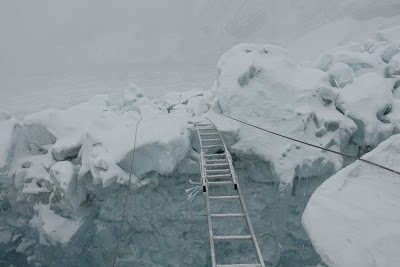
Here is a pic of a couple ladders lashed together over a crevasse. Note the nice bend in the end of the ladder!  I enjoy crossing these and have pretty good balance. However, it was one like this that I sort of fell off. If you notice, there are two ropes on either side of the ladder. The idea is that you hold the ropes to give a little extra stability as you cross the ladder. The ropes are anchored into the ice on either end. Then, after you cross, you clip back into one of the ropes after the anchor point to continue on, up or down the mountain.  However, on one ladder, when I was half way across the anchor came undone. As the person clipped into the rope on my left and proceeded on, it pulled me to the right and into the crevasse. But everything worked as it should. I was clipped into both ropes and only took a short fall ending up in a tangle of rope hanging upside down. After catching my breath, I righted myself and was able to climb back out on my own. Not a scratch!


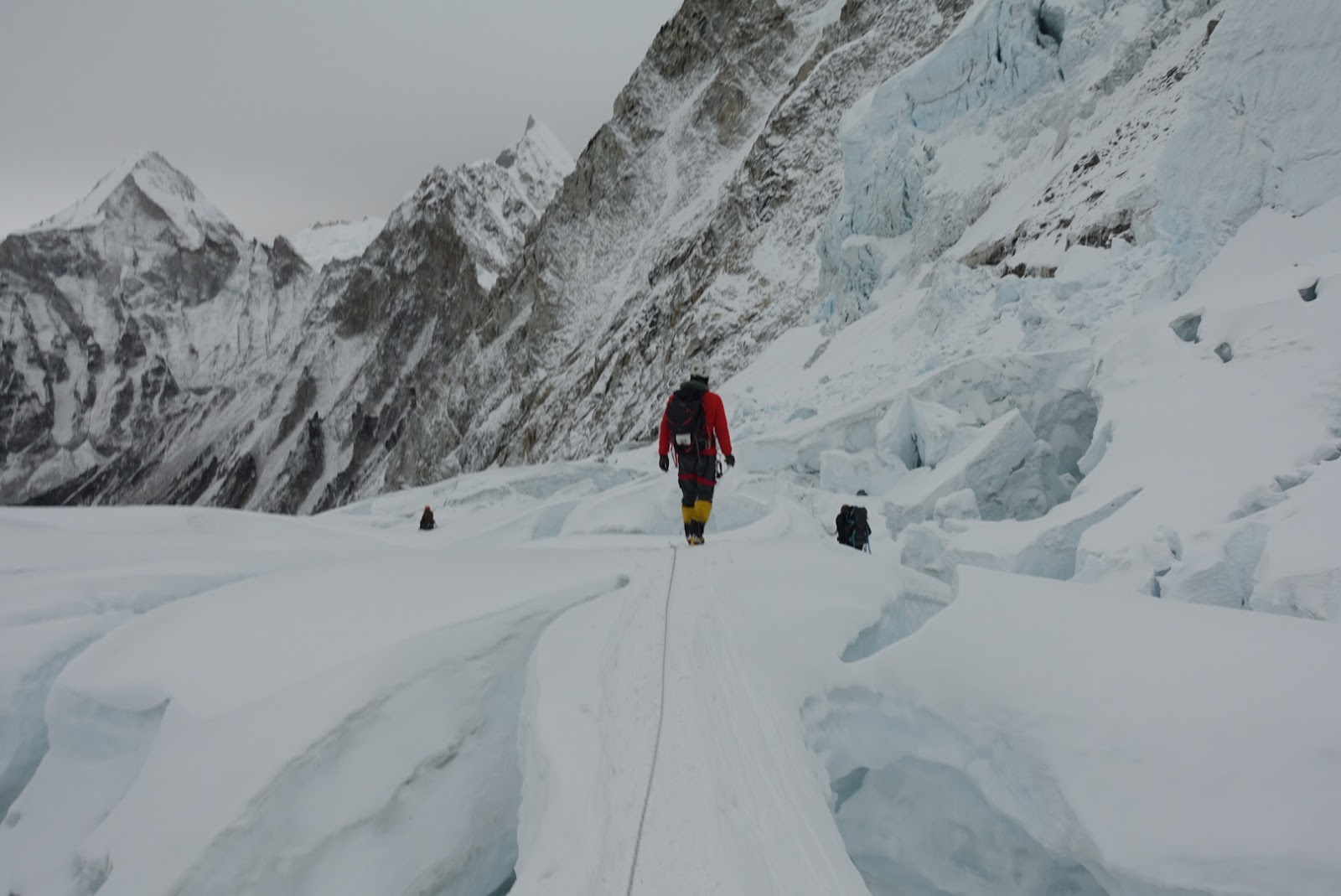
Here is a pic of John, a fellow climber crossing a snow bridge over a crevasse.


And another shot of John descending a section of the icefall. This up and down climbing was a blast!


After making our way through the icefall we continued up and down large crevasses until the terrain became mostly solid snow. That was where you find Camp 1. Camp 1 is basically some tents on ice. Dinner was freeze dried food, which never entirely becomes un-freeze dried at elevation.  Not a huge fan. I settled in for the night and tried to endure the cold, upset stomach, and pressure headache.  I've found that day time and climbing is a load of fun but at night the fun diminishes a tad and it feels more like enduring the environment.

The next morning we woke up, had a breakfast of cold oatmeal and traditional Nepali tea, and got moving up the mountain towards Camp 2. It was a good hike. Relatively uneventful as we steadily plodded higher. We made good time I was told. My Personal Sherpa assigned to follow me and make sure I stay out of trouble (now where was he when I went in the crevasse?) was by my side the whole morning. He is a super strong climber who not only carries his gear and a bit of mine but also oxygen bottles and other gear needed higher on the mountain. Here is a pic of Sherpa Lakpa. Really nice guy!


Camp 2 was nicer than Camp 1 in that it had a small kitchen tent and a larger, flatter area for our tents.  I never sleep great the first night at a new elevation. Maybe 3 hours. But it is what it is.

The next day was a big deal. The challenge was to climb the Lhotse face, a challenging steep mix of rock, ice and snow, to Camp 3. Elevation 23,625 feet, no oxygen. This is about 3,000 feet higher than I've ever been. The climbing was not particularly difficult for me in terms of skills or leg strength, but the the altitude blew me away. Towards the end of the climb I was taking 10 deep breaths to a single step! Unfortunately, since I was preoccupied with a steep wall and breathing, the camera stayed put on my hip, so I can't give you and image of this part of the climb. After "touching" Camp 3, we quickly rappelled down to Camp 2 in a fraction of the time it took to get up.

After a relatively good night's sleep, we headed back down the mountain to Camp 1, then through the icefall, and back to Base Camp. Going back down felt great. I got stronger with each step as more O2 hit my lungs. I went pretty fast through the icefall ahead of the team simply from feeling so good. Touching Camp 3 and zipping through the icefall on my first rotation gave me good confidence for the work to come. My guide said I was equal to the rest of the group that had made two rotations. Surprisingly, I have no sore muscles, and more importantly I am well at the moment. All is well and I am committed to staying on the ladders and out of crevasses in the future!


Wednesday, May 3, 2017

Final prep for first rotation

This was our last rest day before heading up the mountain for some real climbing. I can't wait to get going. 

After breakfast Conan, John and I headed out for a quick 2 hour hike of a nearby peak. I still get winded going up but have definitely improved since I first arrived in base camp. At the top of the peak it was rather cold and windy but we were treated with incredible views.  In the picture below, you can see Base Camp spread out across the left side of the glacier. I was told the tents likely stretch across a mile to give you some perspective. The large mountain towards the center is the west ridge of Everest. The black peak behind that is the summit peak of Everest. And the pointy mountain in the foreground on the right is Nuptse.


After our short hike and lunch we discussed logistics with Conan for my first move up the mountain. What to bring up.  What the Sherpa carry vs. what we carry.  I will have a Sherpa, named Lakpa, with me every step of the way.  Then we packed and laid out everything so that when it was time to go we could be ready in very short order.  We will wake up at 2:00am and head out at 2:30am.  The reason for this early start is to get through the icefall before the suns hits it and the potential for avalanches increase. 

The plan is for us to go through the icefall tomorrow, May 4, and on to Camp 1. We will rest there for 2 nights to get used to that altitude, approximately 19,685 feet. Then we will move up to Camp 2 at 21,000 feet and stay for 3 nights. During the day we will take short hikes to again help with the acclimatization process. On May 8 we will go up and  "touch" Camp 3 at 23,725 feet and then come back down to sleep in Camp 2. We will come all the way back down on day 6, which is May 9.  As info, I will not be able to update my blog during that time so check the Madison Mountaineering website for updates. 

I feel ready, the weather is a bit on the windy side but good, and I am excited to go higher. Wish me luck!

Ladder practice

Today, Tuesday, John and I hit the icefall again for more training. This time the focus was getting comfortable crossing ladders as there will be many of these spanning crevasses and steep sections of the icefall. We practiced going up and down, low angle and then high angle, as well as flat to the ground.  There are a number of techniques to master with ladders making use of ascenders, carabiners, ropes, proper foot placement, etc.  We again rappelled from the tops of "icebergs".  My Dad and Mom got me into Boy Scouts early on which provided my first exposure to rappelling and I've enjoyed that ever since. God blessed me with good balance so this was all 100% fun for me. I'm very excited to get out in the real stuff.  Fun as it will be, it can take 5-12 hours to get through the icefall and to Camp 1 based on the main climbing group that has already done it. It will be work. But fun work. 


So far, knock on wood, I am healthy. I would guess 1/2 to 2/3rds of the team has some illness from a cold to respiratory infection to our poor chef who tore some rib muscles from persistent coughing. They even have a name for this, the Khumbu Cough, after this region of Nepal. I'm a bit of a germaphobe - ask Lauri or my coworkers (Vicki 😉) - so maybe that has paid off here. As far as sleep, it is improving. Last night was my best by far with 5 hours. Boy that felt good!

Tuesday, May 2, 2017

First icefall practice

Today John (the climber who came in a week before me) and I practiced our climbing and rappelling skills in the icefall. The icefall is a massive glacier which looks like a huge jumble of house sized ice cubes.  Glaciers act essentially like a river only frozen and in slow motion. To make our way through this river the "ice fall doctors", the top tier of Sherpa climbers, set the course based on their knowledge and experience. The way through the icefall not only changes every year is re-routed within a climbing season a number of times due to movement in the icefall. I can't hear it popping and cracking each night plus the occasional avalanche each day when the sun comes up. These are normally not an issue. 

Typically people have a rest day before tackling icefall training but Conan, the guide who has been with me the whole time, felt I was ready. It was great fun but I sure did get winded climbing the vertical ice walls without an ice axe. I've done the least of this kind of climbing so I relied more on strength than skill, which is not a good thing. Regardless both John and I got good marks and zipped through the course since there were only two of us.

In the afternoon I rested. I also got to meet the two private climbers who were coming down from their second rotation. So now I've met the whole team. 

Here's a shot of me ascending one of the easier walls.  Plenty of good spots for foot placement. The hard ones are those that are flat, vertical sheets of rock hard ice. Bleck. 


Monday, May 1, 2017

Everest Base Camp

On Sunday afternoon I finally made it to Everest Base Camp! We got up early and trekked from Lobouche past Gorak Shep and straight into base camp. The elevation gain was approximately 1,400 feet with base camp coming in at 17,600 feet.  I felt strong on the trek but once again felt the elevation. Coming up the last hill I met 2 of the members of the team Audrey and Ingvild, who were going on a short hike to stretch their legs. Shortly after I met most of the rest of the team and the other guides.  It was great to finally feel part of the expedition. 

As I was getting settled in, Garrett, the lead guide and company owner, called an impromptu meeting before dinner. He informed us that there had been an accident on the mountain. Uli Steck, a famous climber and machine in the mountains had fallen and died. He was preparing for an highly aggressive and technical route crossing Everest and Lhotse. Garrett asked us not to share any info out of respect for the family until the news had published the facts. It was a very somber moment. I think most of us climbers did not think twice about what we are doing. For one, what Uli was attempting was a very different thing from our route. We were more worried for our families who heard the news and would be reminded of the risks. 

After getting settled in my tent I made my way to the giant eating/movie tent, which is also heated!  The mood was a mix of the bad news combined with the excitement for most of the team who were preparing to go up the mountain for their second rotation with a 1:30am start. For that our base camp chef prepared T-bone steaks, potato wedges, fried onions, salad and more. I heard the food was good with this company. All companies claim that, but Chef Anthony is the real deal. He goes from gig to gig. Everest base camp one month to serving on a private yacht in Monaco the next. 

Here's a photo of me at the prayer flag covered entrance to Everest Base Camp (EBC). 


A pic overlooking the Khumbu icefall.


A shot of part of our camp. Top two tents are a couple of the guides tents. The climber tents are below. My home for a few weeks is the tent on the left on the bottom row. And the smaller funny shaped tents on the far left are the latrines. These are a major step up from many places I've been which are basically holes in the snow, nothing protecting from the bitter wind. 


Saturday, April 29, 2017

A glimpse of base camp

Last night was another rough one. I didn't really sleep at all. I would drift off and almost immediately wake myself gasping for air. This is a normal part of acclimating but is not so fun. I was glad when the morning came and I could get up and get ready for the day. 

For my second day in Lobouche the plan was to go for another hike, gain a little more elevation and keep the blood flowing. We set out behind the tea house and up a trail. We reached an elevation of 17,200 feet, or 1,000 feet of gain, which is just a little shy of base camp elevation.  Again, I felt the elevation in the form of heavy inhaling and exhaling and some pressure in my head. However, there was a nice reward at the top. I got my first glimpse of Everest base camp.  In the picture below, in the dead center is the Khumbu ice fall. You can't see it in this photo but there are dozens of tents sprawled out along the left side of the ice fall. The large bullet shaped mountain to the left is Pumori and the large mass on the far right is part of Lohtse.  Everest is hidden behind Lohtse from this view point. 


This shot is looking in the opposite direction. I don't know the names of these mountains but you can see how the same glacier coming from the Lohtse icefall has carved its way through the valley. 


Here's a look at my 5 star hotel room. I shared one like this with the guide in Dingbouche. This time I could spread out a bit more as I had an entire room to myself!  Talk about luxury. No heat though.


Friday, April 28, 2017

Lobuche

The objective for today was to move up from Dingbouche to Lobuche, a roughly 1,700 foot climb to 16,207 feet. Even though I had fully acclimated to Dingbouche, I definitely felt the altitude on the hike. I've felt it many times before though. A pressure headache coupled with taking deep breaths to walk up something that would be absolutely nothing at home. But this is normal. As long as I don't get a crushing headache or nausea or vomiting it's all part of acclimating. The plan is to rest in Lobuche for the rest of today (it's Friday here) and the following day as well.

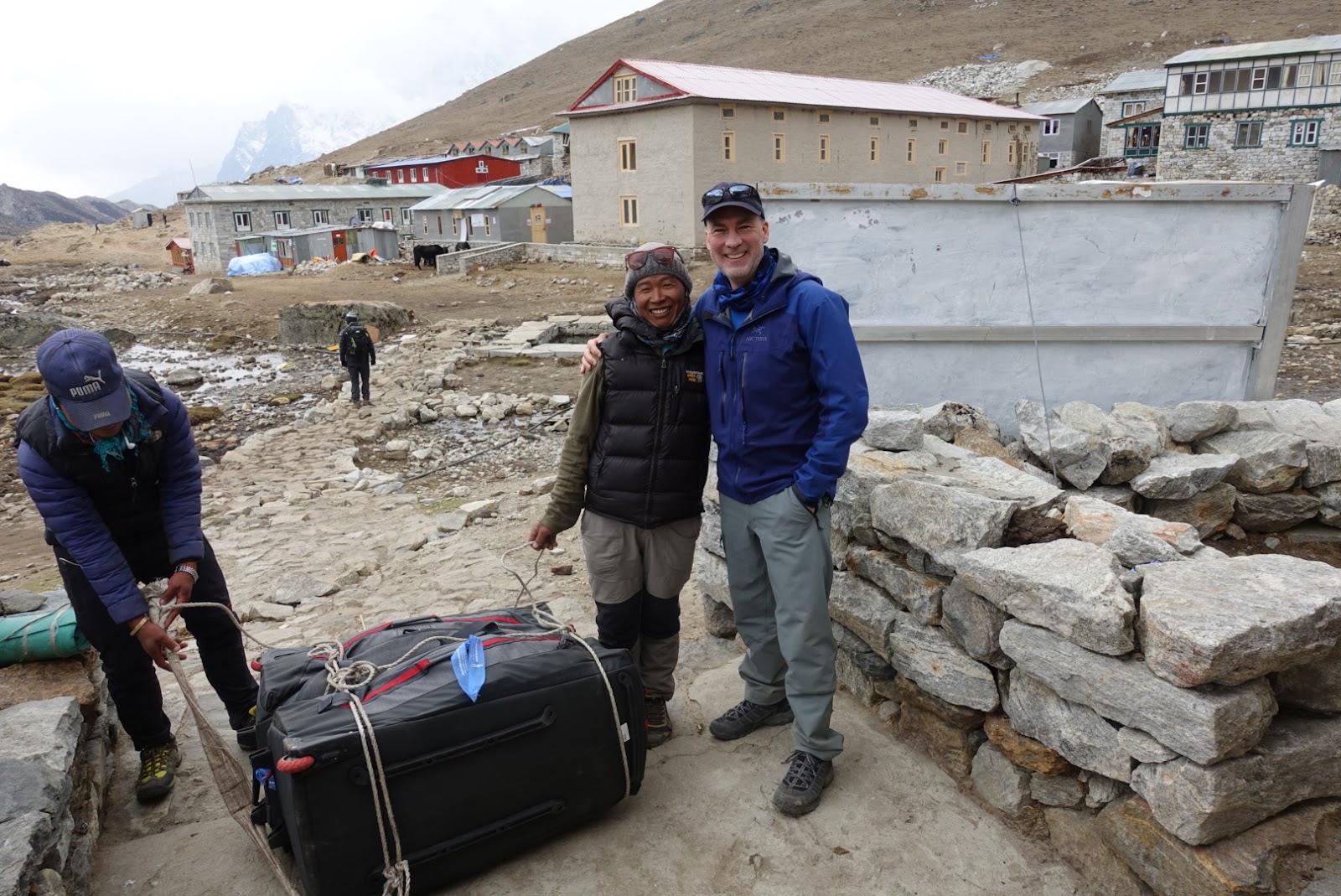
As much as I felt the altitude today, I was blown away by the porter who carried much of my gear. See the pic below. He carried all three of my bags, the gray and black ones, plus someone's else's small pack. My gear (which included the last minute requests of other climbers) had to weigh at least 160 pounds!  The Sherpa are amazing athletes and make us Western climbers look quite weak by comparison. I should also note this is the normal way Everest is climbed, expedition style, really from the beginning. The mountain is really too big for an individual to take everything they need with them so porters and Sherpa play a key role in moving the expedition up the mountain. Other mountains are climbed differently. On Denali for example we all carried all of our gear and divided up the group gear on top of that. I may have had 150 pounds tops but that was split between a pack and a sled vs. all on my back. I was very impressed by this guy. 


Another way gear is moved is by yak. The ones in the picture are actually a cross between yaks and Indian cows. I'm told they are stronger and better mannered than pure yaks. Who knew?


This is a pic of me shielding myself from the sun. The Buff is my best friend out here. 


Today we also walked through the memorial to climbers who died on the mountain. This one is in memory of the famous climber Scott Fischer. I knew there was a memorial area but was surprised to see that there were dozens and dozens set up in this area. It was a somber place, and a place for reflection.


Wednesday, April 26, 2017

Starting to acclimate

I didn't sleep much last night. Probably a combination of jet lag and the altitude. And maybe that nap I took late yesterday.  I awoke with a small headache but felt pretty good overall given the rapid ascent to this elevation. After a breakfast of pancakes with honey and more milk tea, my guide Conan and I set out for an acclimatization hike above the village of Dingbouche. When I arrived the night before I failed to realize I was in the midst of some of the most famous peaks in the Himalayas - Ama Dablam, Island Peak, and Lohtse are all visible. It was clear in the morning for our hike. We set out at a slow pace and only gained 1000 feet to ensure I didn't over do it. I felt really good. No headache. One person on the trip already went home due to not being able to acclimate to the altitude.

I should explain that I am doing this on a much shortened schedule and will be the last person in my group to reach base camp, maybe the last climber on the mountain period. I could not take 2 months off from work so am doing this within my vacation.  The program involves sleeping in a hypoxic tent for 45 days prior, simulating towards the end being at 14,000 feet right in my bedroom. (Side note: Lauri loved the tent and really wanted to join me in it but somehow never did.) In addition I am skipping much of the trek in to base camp that the rest of the team experienced. Together this will cut in half the time it normally takes, assuming I can acclimate.  This has been done before so hopefully I will acclimate OK. 

This is at roughly 15,500 feet with Ama Dablam, elevation 22,349, prominent in the background. It looks like two separate mountains but both are really part of the same and are connected by a ridge we cannot see from this angle. 


The adventure starts now

Today was another travel day getting closer to the mountain. After a few hours of sleep I met Rajan, my driver in Kathmandu, to head for the airport a little before 6:00am. I flew to Lukla next via helicopter. The Lukla airport is named the Tenzing - Hillary airport but also is nicknamed the scariest airport in the world due to its angled approach and short mountain runway. The elevation there is 9,334 feet.  All of this definitely made me feel like the adventure was really starting as the comforts of home gradually faded behind me with each leg of the journey. Another sign of adventure, I had to start using my Steripen, an ultraviolet device used to make water drinkable.

Here you can see an airplane approaching the runway.


This is from the internet but gives a good perspective of the runway.


After an hour layover in Lukla airport, where I enjoyed my first cup of steaming milk tea, I continued on to Dingbouche, evelation 14,469.  I definitely felt the elevation. It's like flying directly to the top of Mount Rainier and getting out.


Monday, April 24, 2017

A couple pics of Doha, Qatar where I had a 10 hour layover enroute to Kathmandu. 


Saturday, April 22, 2017

Heading out!

The day has finally come. I'm packed and ready to go!  Just a quick jaunt from Charlotte to Chicago to Doha (10 hour layover) to Kathmandu to Lukla then helicopter to somewhere below base camp to begin trekking. I'm ready!  And gray might be my favorite color.